

Joint Award Winner
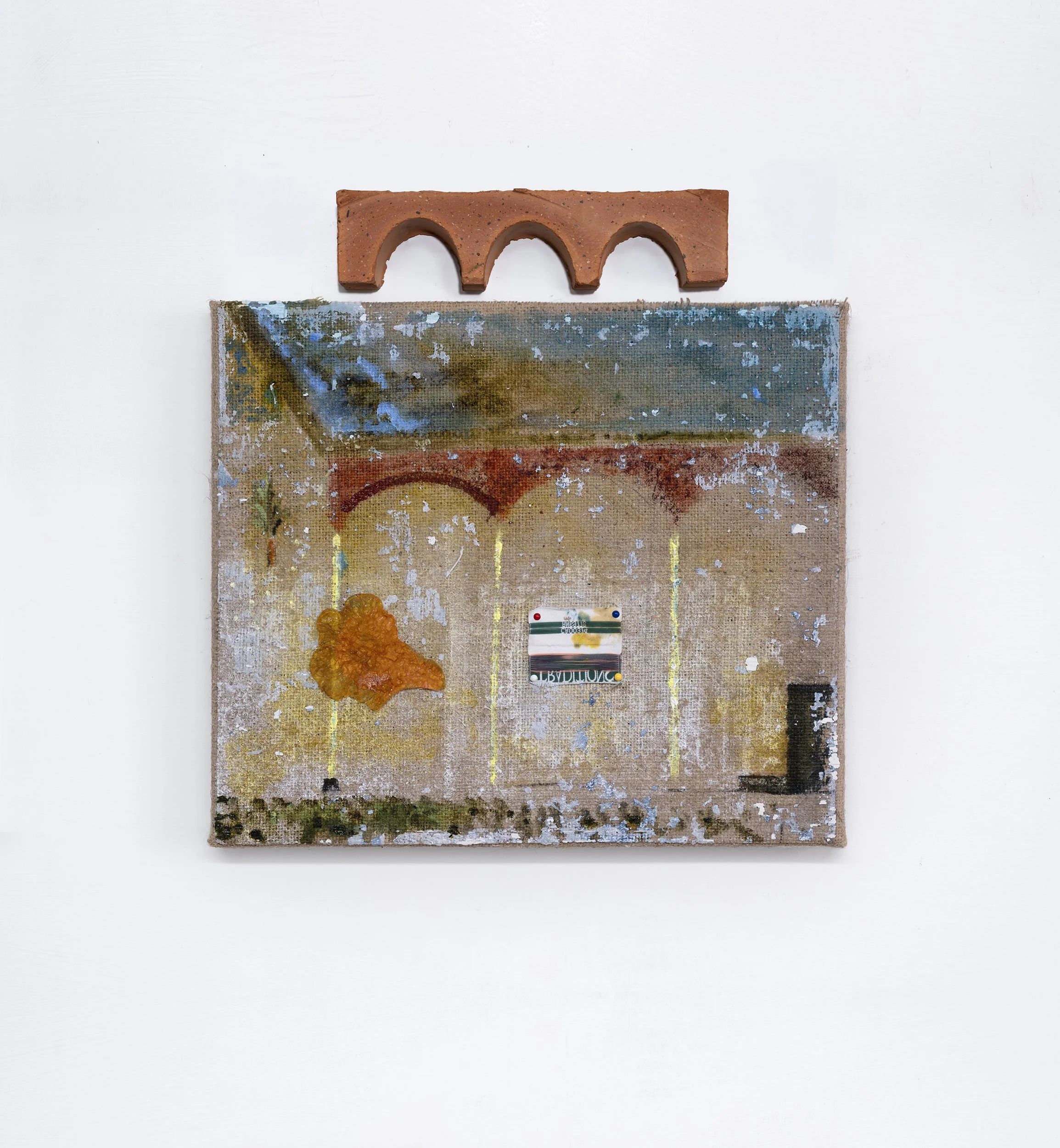
Piers Alsop‘s practice incorporates painting, drawing and collage in which themes of impermanence, ruin, and the artifice of painting exist in an ongoing dialogue with art history. Drawn to ordinary scenes - roads, gardens, buildings, interiors, piers and landscapes - his stylised compositions oscillate between a gentle humour and the anxiety of decline. Collaged fragments - such as burlap offcuts, used sandpaper, commercial packaging, and dried up paint - are stapled, pinned, or glued into place, reinforcing a sense that the whole image could perish at any moment. They act almost as postscripts to the painting, modest reminders of the process of their making.
Alsop hopes to create transitory moments suspended in time, held in a state of ambiguity - an ongoing duel between fragile contradictions, vulnerable perimeters, rhythmic repetition, moribund murmurs, the sacred & profane. His paintings consider ways in which a two-dimensional surface can be inhabited, employing a pared back aesthetic, a considered ‘slouchiness’ and generous negative space.
Joint Award Winner
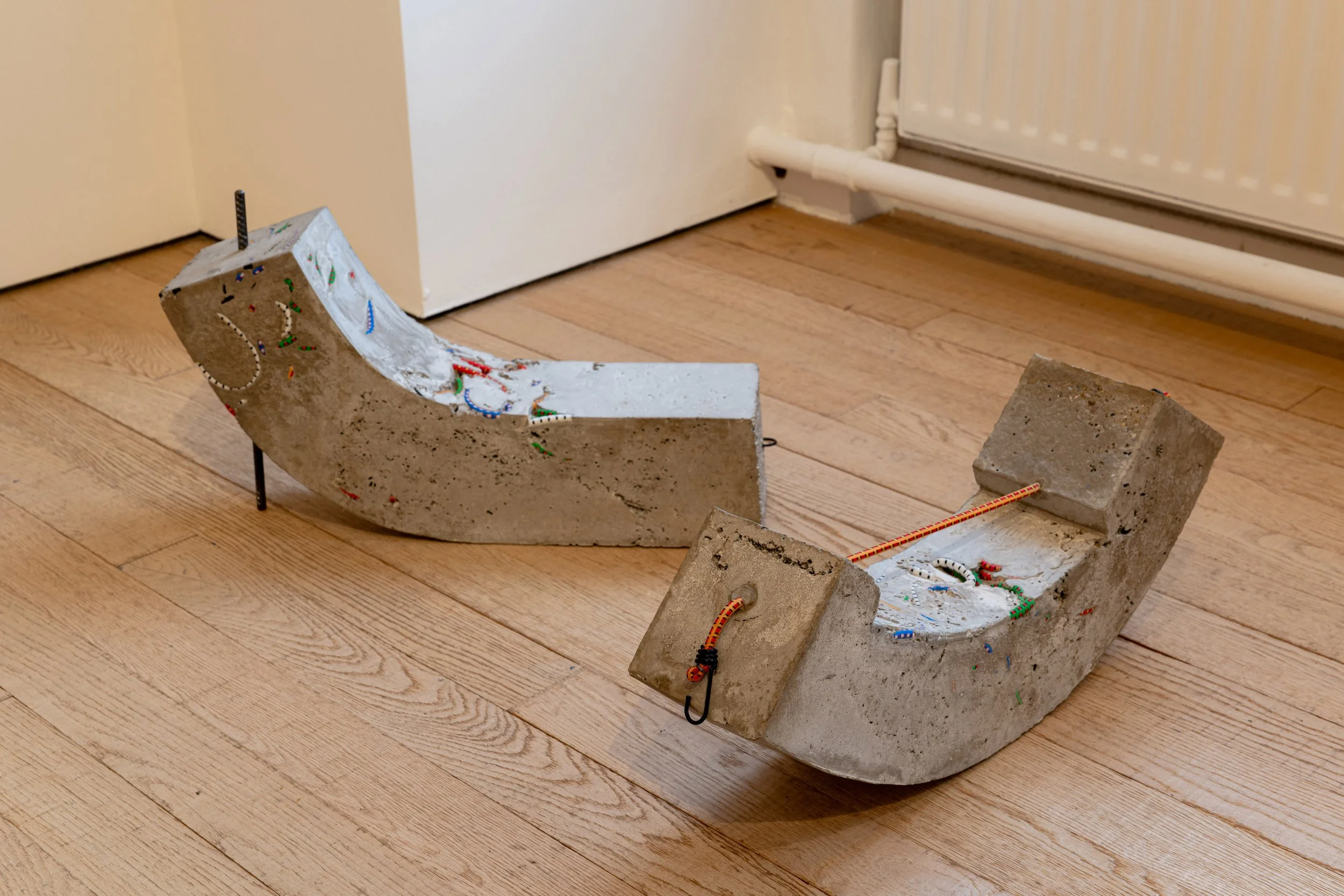
Dolly Kershaw is a sculptor and cabaret performer based in Cornwall who reimagines everyday objects with deadpan humour and a tragicomic outlook that combines the personal and political. Her works often struggle against themselves, their material choices negating their own efforts, implying embarrassment and failure.
These three pieces aim to create improbable illusions and contradictions of form, where the concrete appears to be bending to the will of the bungee cord. They were inspired by a trip to Senegal, where unfinished concrete foundations can be seen on every street, their bent and chaotically arranged steel armatures left exposed until the next stage of construction. They seemed to humorously convey a nonchalance about being perceived or judged for their structural integrity, which Kershaw related to the conflict between revealing and masking mental illness. Their armatures may be seen as spiritual backbones that are replaced with both taut or loose bungee cords to convey trapped stress as well as an acceptance of chaos and unpredictability.
Joint Award Winner
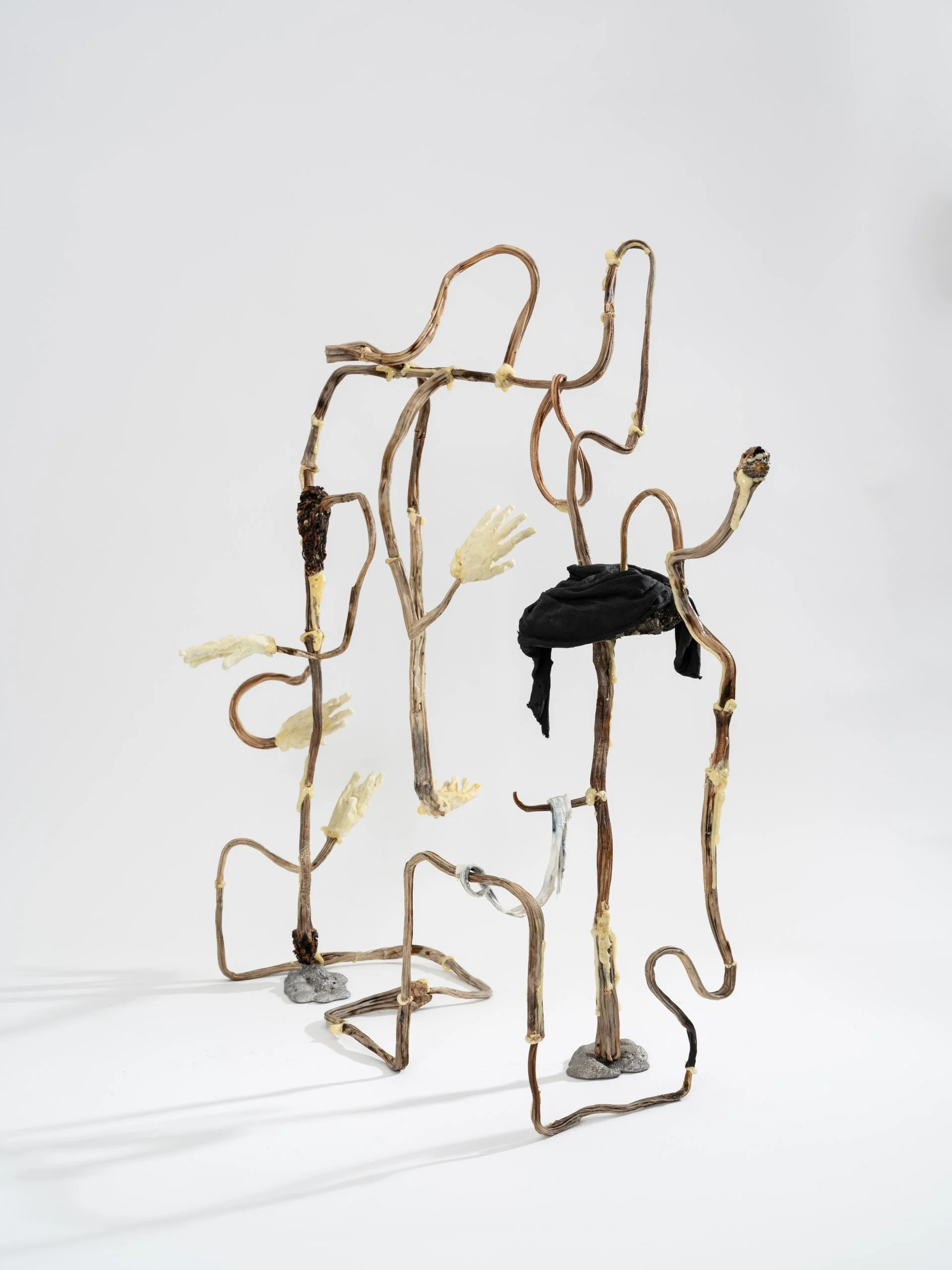
Sebastian Thomas’ interdisciplinary practice centers on the process of assemblage - combining fabricated elements with found materials in collaged sculpture, installation, painting and print. Drawn to the relationship between the body and the landscapes it inhabits, his sculptural works focus on the idea of the body as an evolving scaffold - an extruded bodily form that is in flux and trying to escape the confines of the financial, political and technological systems that are imposed upon it.
Thomas uses the transformative power inherent in materials as a metaphor for our own bodies’ capacity for change. He consciously utilises accessible materials that are naturally occurring, cheap or recyclable, rather than ‘fresh’ materials or expensive processes - collecting, melting, and casting scrap metal himself, alongside digging, processing, and firing clay to produce sculptural elements. For example, experimental materials such as dried and peeled seaweed stems threaded over wire, are supported by weighted bases cast pewter melted over a driftwood fire on the beach.
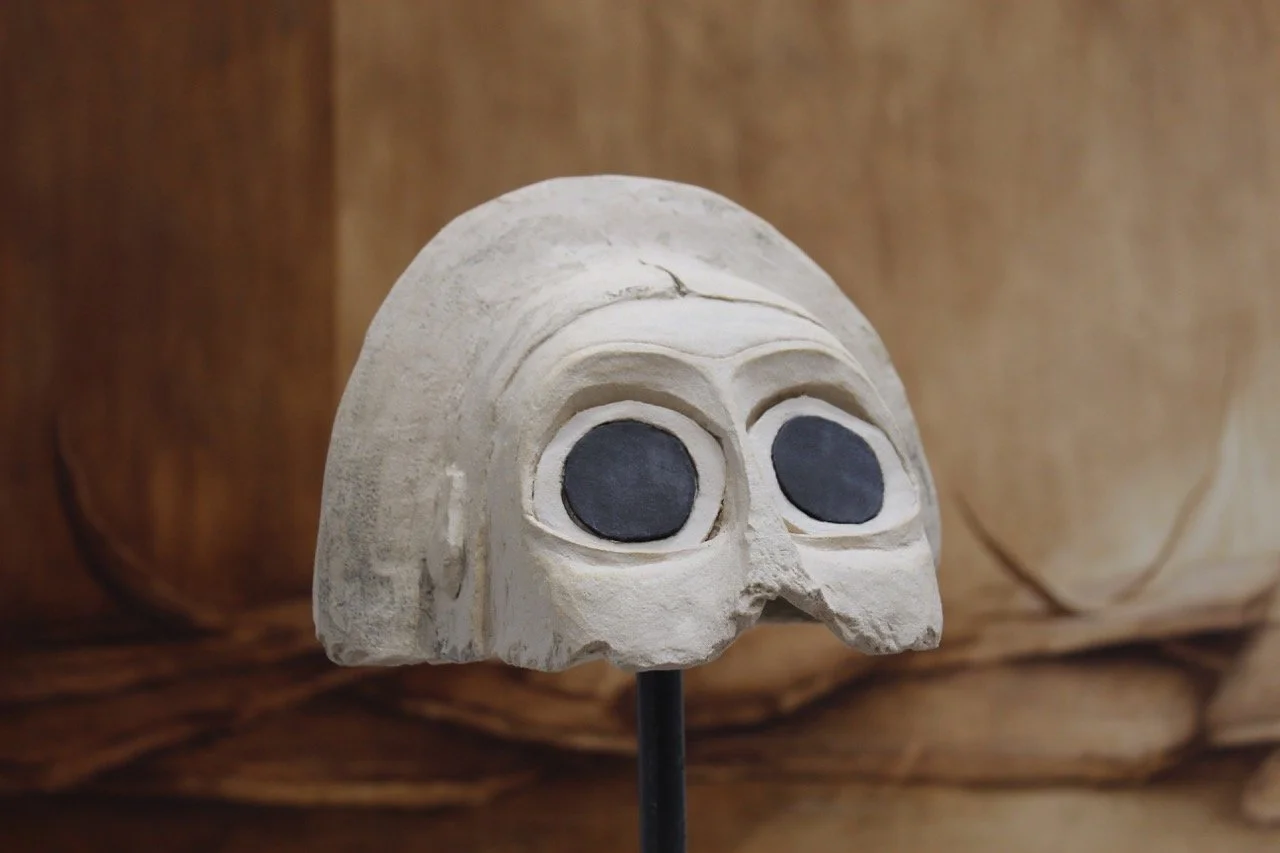
Nahraine Al-Khafaji is a Bristol-based Iraqi-British artist, raised between England and the Middle East. This contrast in culture informs her study of ancient Middle Eastern history and its significance in the current Western world she resides in.
Her practice explores the fragility of Iraqi histories after catastrophe and conflict, where pasts once well documented are later found destroyed and unintelligible. Troubled by recent destruction of archeological sites and artefacts, her work mourns significant losses of the earliest civilisational histories. In her paintings, the physical removal of applied paint serves as a metaphor both for the excavation of artefacts and, contradictorily, the erasure of information. This laboured scratching of the surface mirrors the manner in which histories have been stripped away by recent decades of war and terrorism, leaving behind a visual language that descendant communities must attempt to reconstruct.
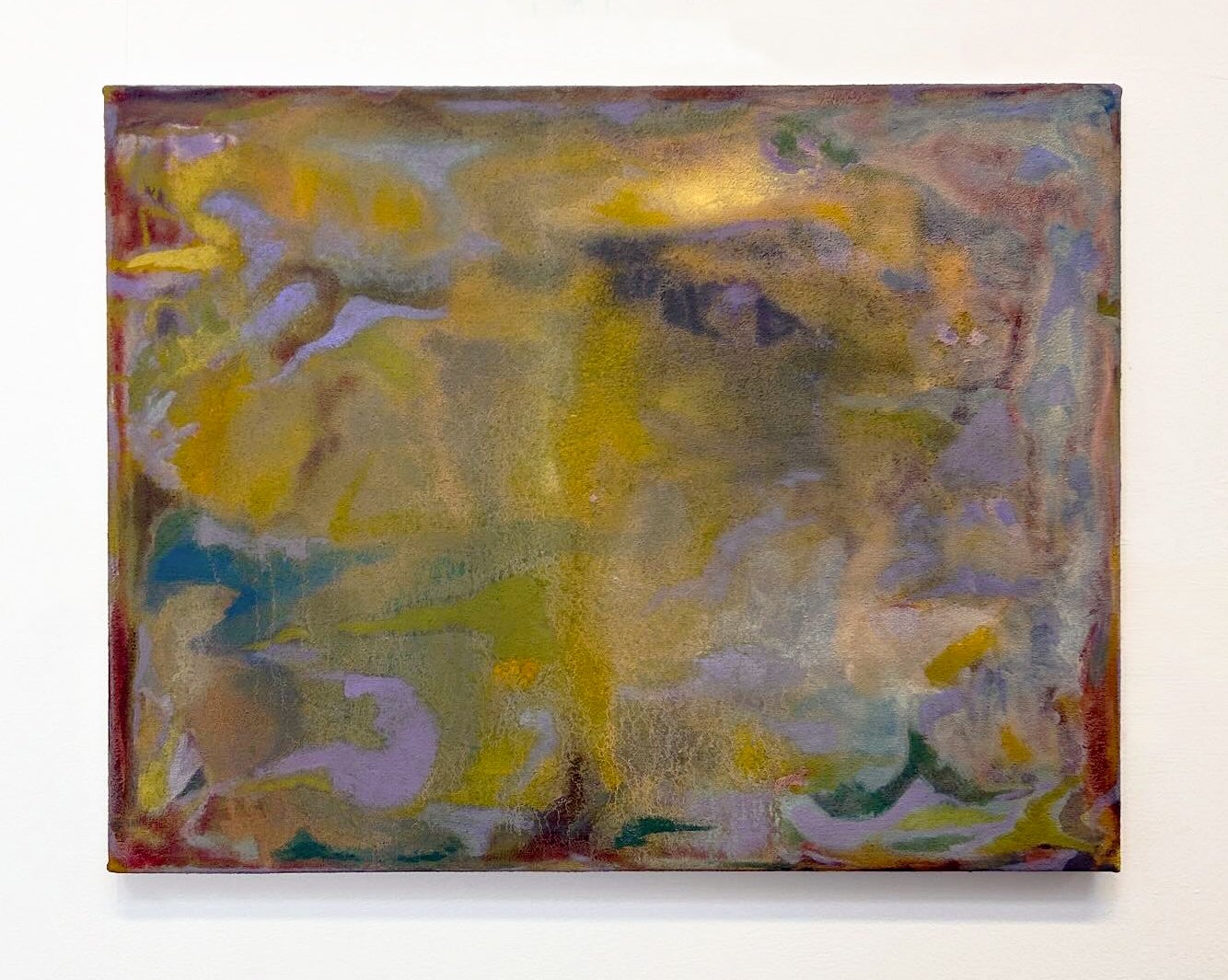
Adam Hedley’s paintings are fluid, amorphous compositions in which recognisable forms emerge from soft, ambiguous fields of colour. Hovering between abstraction and figuration, they create atmospheric spaces that invite sustained looking. He evokes spaces that are simultaneously emerging and dissolving, inviting navigation, speculation, and interpretation.
His work begins with drawing and observation, gathering visual material from the natural world, historical artefacts, landscapes, and a digital archive of collected images and objects. Through this process, thoughts, colour, form, surface and texture are explored and organized, developing intuitively through slow and methodical layering of diluted oil washes and dry-brushed textures. His surfaces emerge gradually, developing into a layered set of impressions, fragments, and atmospheres, suggesting what lingers rather than what is directly seen. In this way, Hedley explores strategies of erasure and emptying, engaging with absence, gaps, and voids, and representation of the invisible.
David Kefford’s practice is centred on transformation, vulnerability and states of becoming. Working with found and salvaged materials sourced from second-hand economies and sites of abandonment, he creates hybrid entities that occupy fluid positions between human, animal and object. Through improvisation, repair and adaptation, everyday objects are reconfigured into bodily forms that appear simultaneously fragile and animated.
Poised between resilience and collapse, the scarred and perforated surfaces, dangling ropes and head-like form of Balance of Being suggests shifting identities, competing selves and the continual effort required to maintain equilibrium.
The Body Keeps the Score takes its title from Bessel van der Kolk’s influential book and considers how experiences accumulate within the body over time. Its two forms appear caught in a reciprocal relationship, their postures suggesting support, dependency, tension and exchange. Bent, compressed and burdened by their own materiality, they reflect on the ways trauma, memory and adaptation become embedded in bodily gesture and physical form.
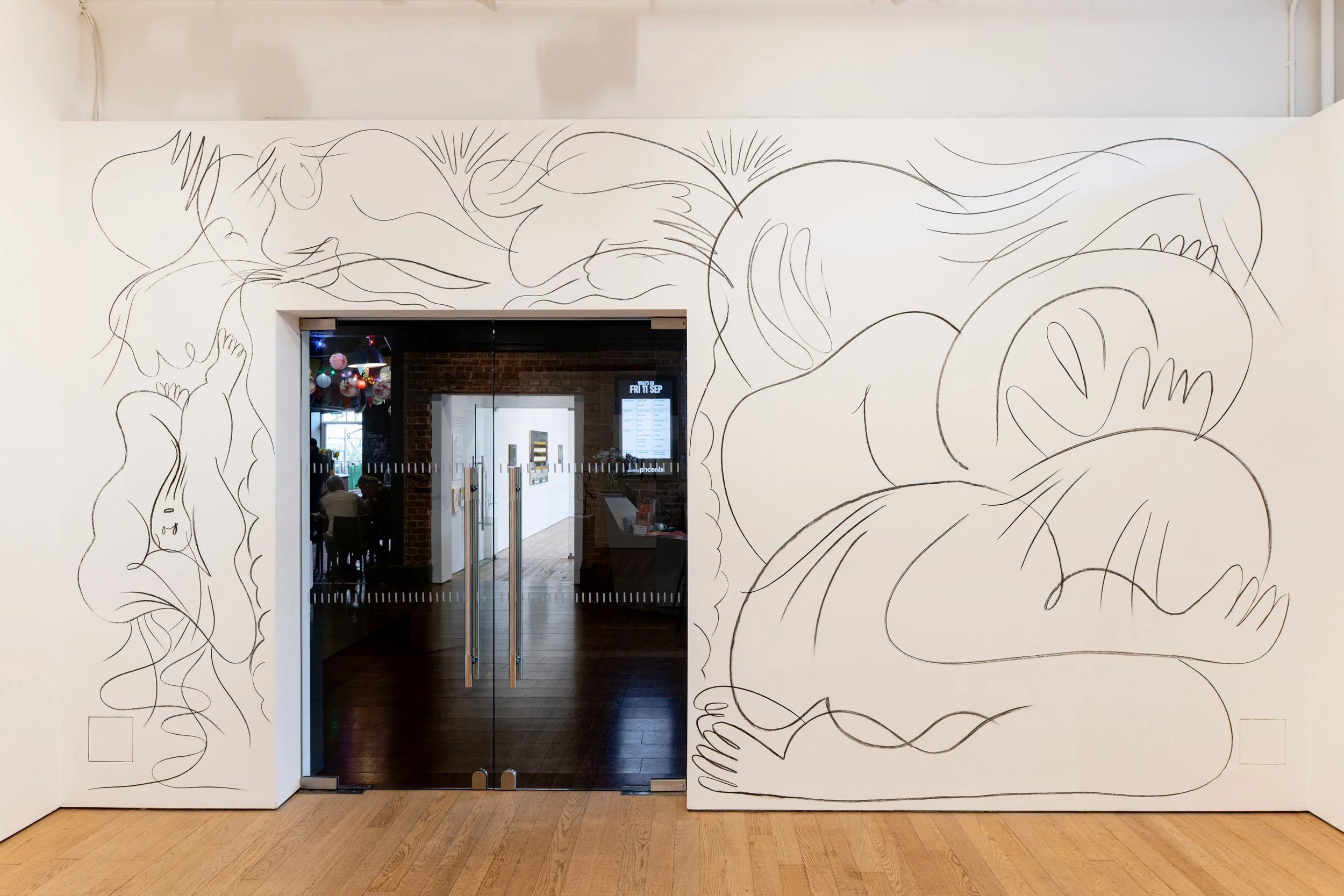
William Luz is an artist who makes work that is about drawing, in a way to think about the personal and performative activity of art making. His drawings often become cut up, reformed, layered and pieced together to make documents of action, collages of many little moments. They also appear in video work that reflects back on this action, thinking about process and trying to look at drawing from a different, embodied, and expanded angle. He pays with different modes of presenting, displaying and staging drawing and the physical act of its making. These include grand scale wall drawings, drawings on large rolls of paper, and drawings on fabric, that hang like curtains in space to suggest the performative, perhaps theatrical nature of producing such gestural works. These embodied actions are often augmented with video, sound, text and smaller drawings collaged and compressed between Perspex.
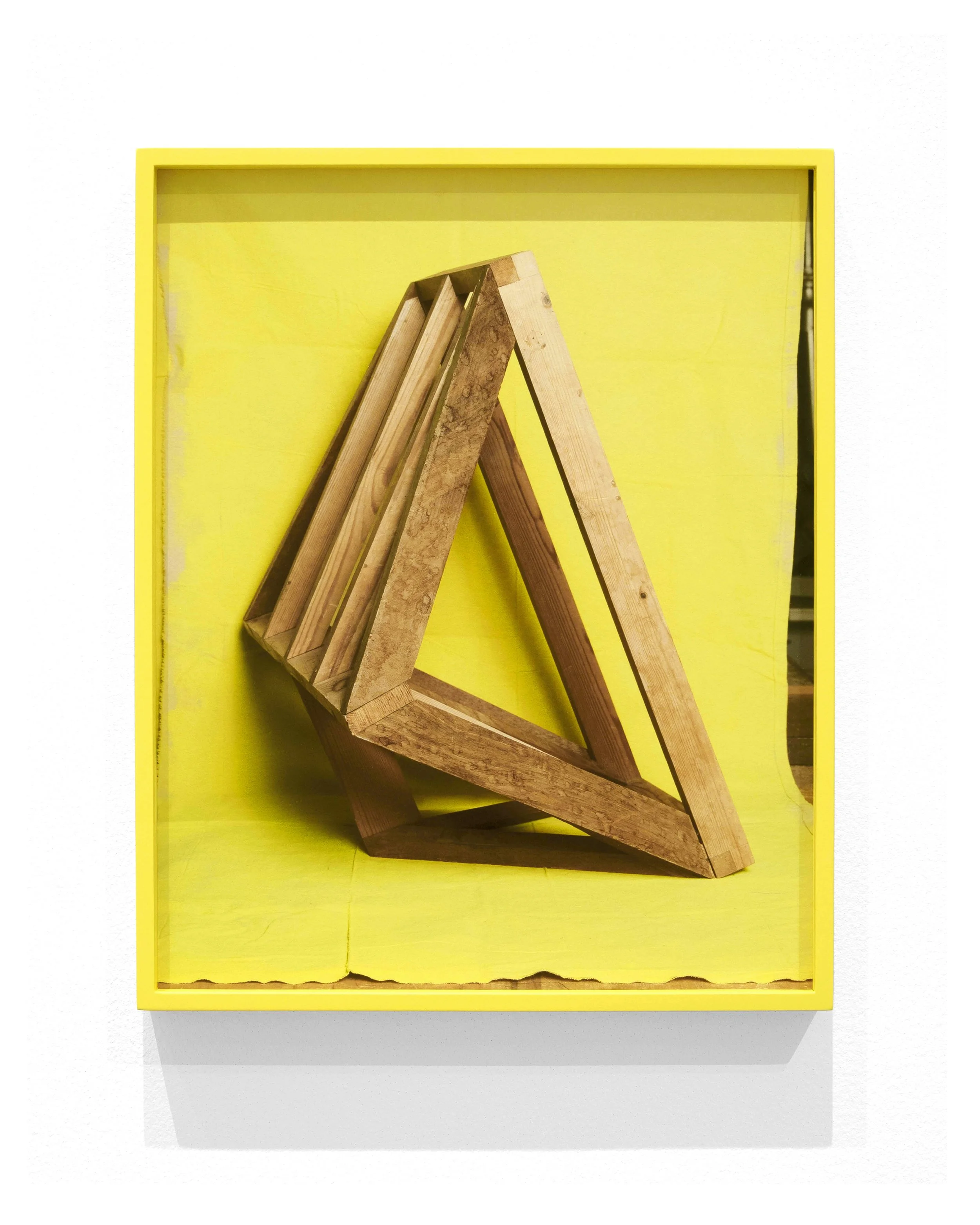
Jan McCullough is an artist from Northern Ireland. Her work explores the human acts of construction, fabrication and DIY, and the communities of interest and place that form around them - employing the materials and languages associated with these activities to create sculptural installations, interventions and photographs.
These works are from a series of photographs of hand-built wooden roof models made by apprentice carpenters working across Ireland. They are collaboratively staged and photographed within the workshops and institutions where they were fabricated.
Rarely seen outside the workshop, these scaled models are the result of a standard learning exercise that encourages student makers to develop and test a range of complex skills, translating two-dimensional plans into three-dimensional space.
McCullocugh’s images question what forms of labour and making are granted visibility and cultural value. They invite us to think about what exists within and outside of the frame - celebrating overlooked, shared gestures of labour, skill and care that underpin the making process.
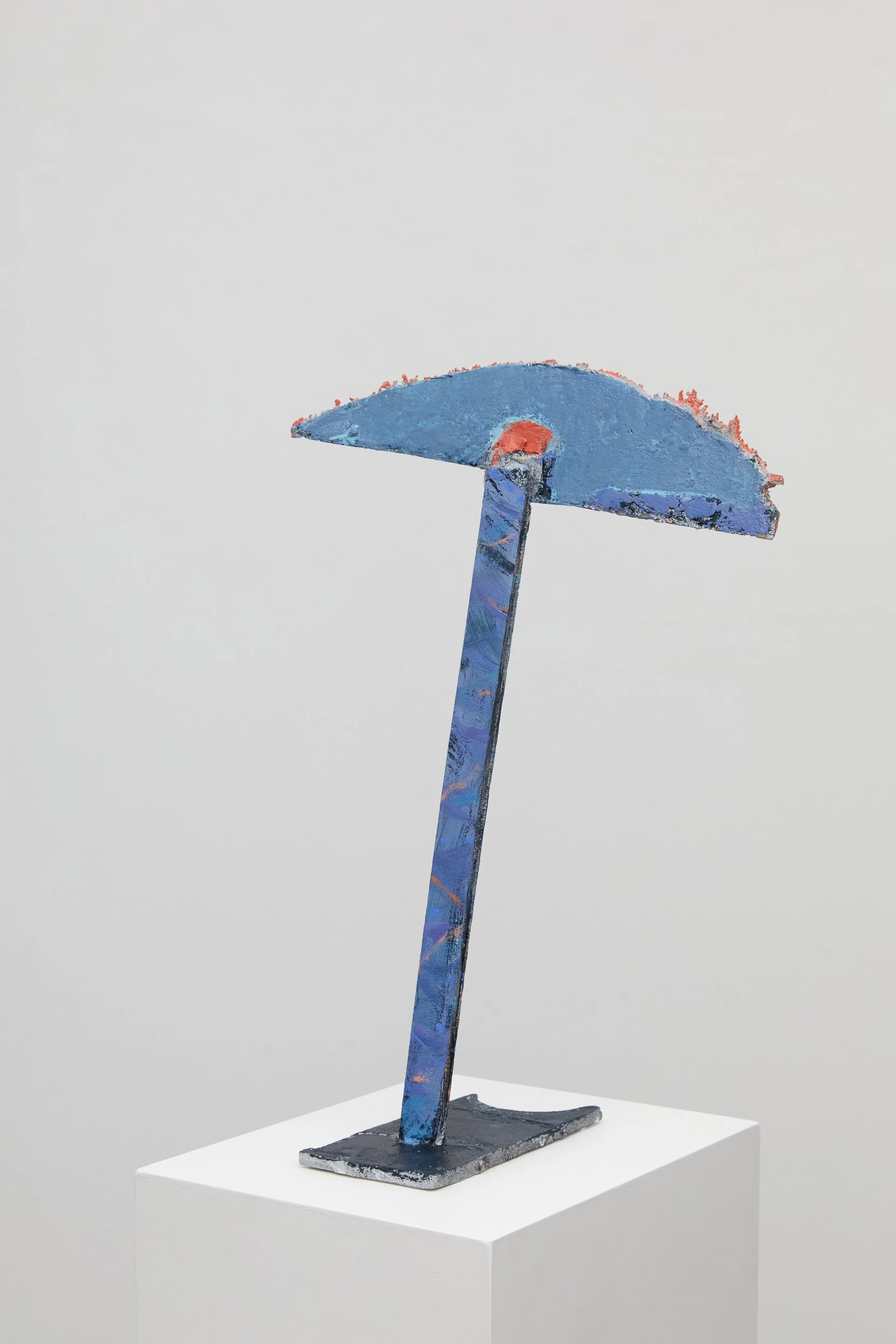
Andrew Miller’s work is closely engaged with abstraction, but the figure is never far away. His painted sculptures, initially made from slender fragments of wood, are then sand-cast in aluminium, rendering them obstinately flat - at times almost vanishing when seen in profile. Casting not only strengthens these fragile assemblages but also provides a particular surface for painting. While their shapes may hint at tools or measuring devices, their flatness resists utility, giving them instead a theatrical quality reminiscent of stage props or cut-out scenery.
Miller works with a shifting space where objects oscillate between categories, recalling the dual function of a butterfly’s wing that operates simultaneously as camouflage and display, as image and semblance. By working this unstable seam, he considers how forms are apprehended and understood, articulating the ambiguity of perception. His work ultimately points to the mutable potential of sculptural practice, where meaning takes shape somewhere within the shifting relations of form, image, and recognition.
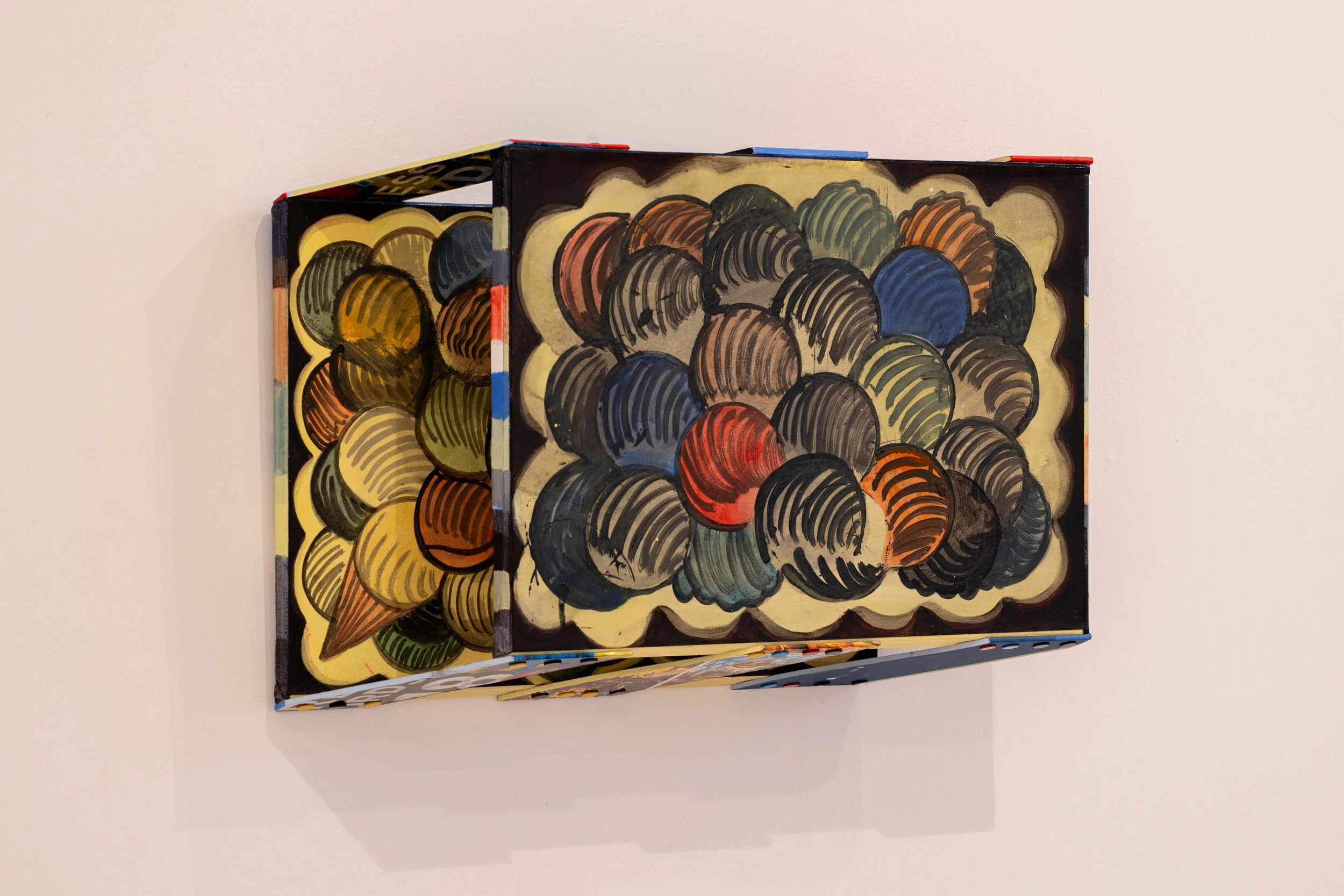
Darren O'Brien is an artist and painter who draws and constructs works primarily on A3 paper and canvas. Working in sequence, often with humour and an inherited sense of Punk irreverence, he allows drawings to play out again and again to allow variation and mutation to occur, drawing out ideas so that peripheral notions can drift forward. His abstracted imagery and layered use of colour often makes reference to observations of every-day objects and forms, such as book-marks, sheds, tennis balls, and metal gates. Interested in how an idea becomes a drawing, becomes a painting, becomes an object, he uses home-made stencils, repeated motifs, and adds elements of collage. Sections of hard-back book covers may inhabit the periphery of a painting to play with its framing, or else to connect two canvases together into three dimensional ‘double-decker’ painting/objects. These exhibit a parallel nature in which the underneath work is slightly concealed, even harshly denied, while still being important to the front.
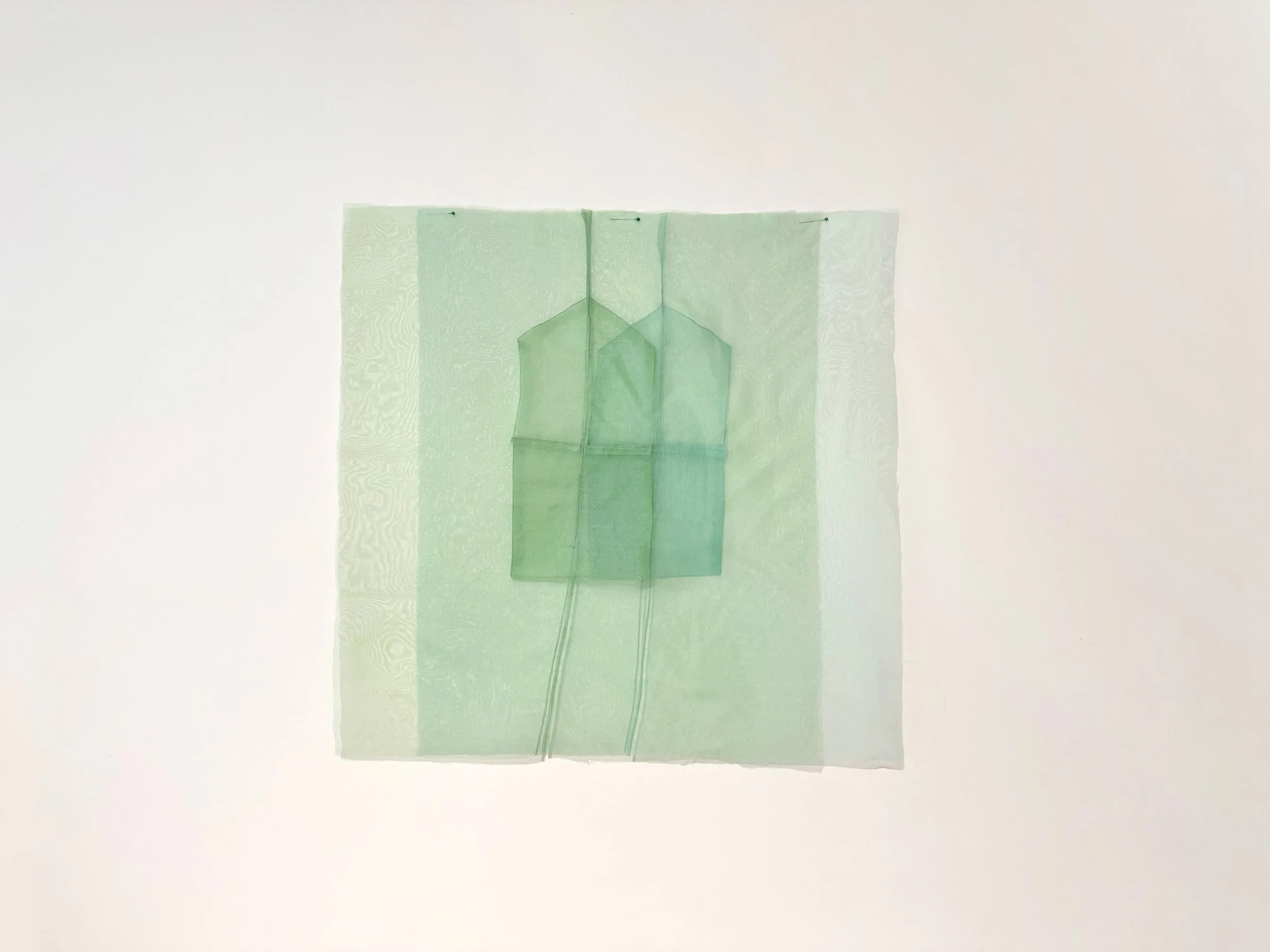
Nisaa Saeed Raja is a UK-based British-Pakistani artist of Kashmiri descent. Working across fibre, painting, and installation, her practice centres on the transformation of everyday objects, as a way of examining memory, intimacy, and the relationships we form with what we keep close to the body. She reflects on personal and collective histories of identity and belonging, and the ways social and political conditions, including migration and displacement, shape lived experience.
Works from the Half a House series focus on the often-overlooked inner pocket of the Shalwar Kameez (a traditional South and Central Asian garment). Considered in isolation and reconstructed in layers of translucent organza sourced from Pakistan, this intimate and concealed element begins to resemble the form of a divided house. Suspended between presence and absence, these fragile architectural forms evoke memories, places, and identities carried across time and distance, resisting the idea of home as a singular or fixed location. They consider what is carried across borders, not only materially but emotionally and culturally.
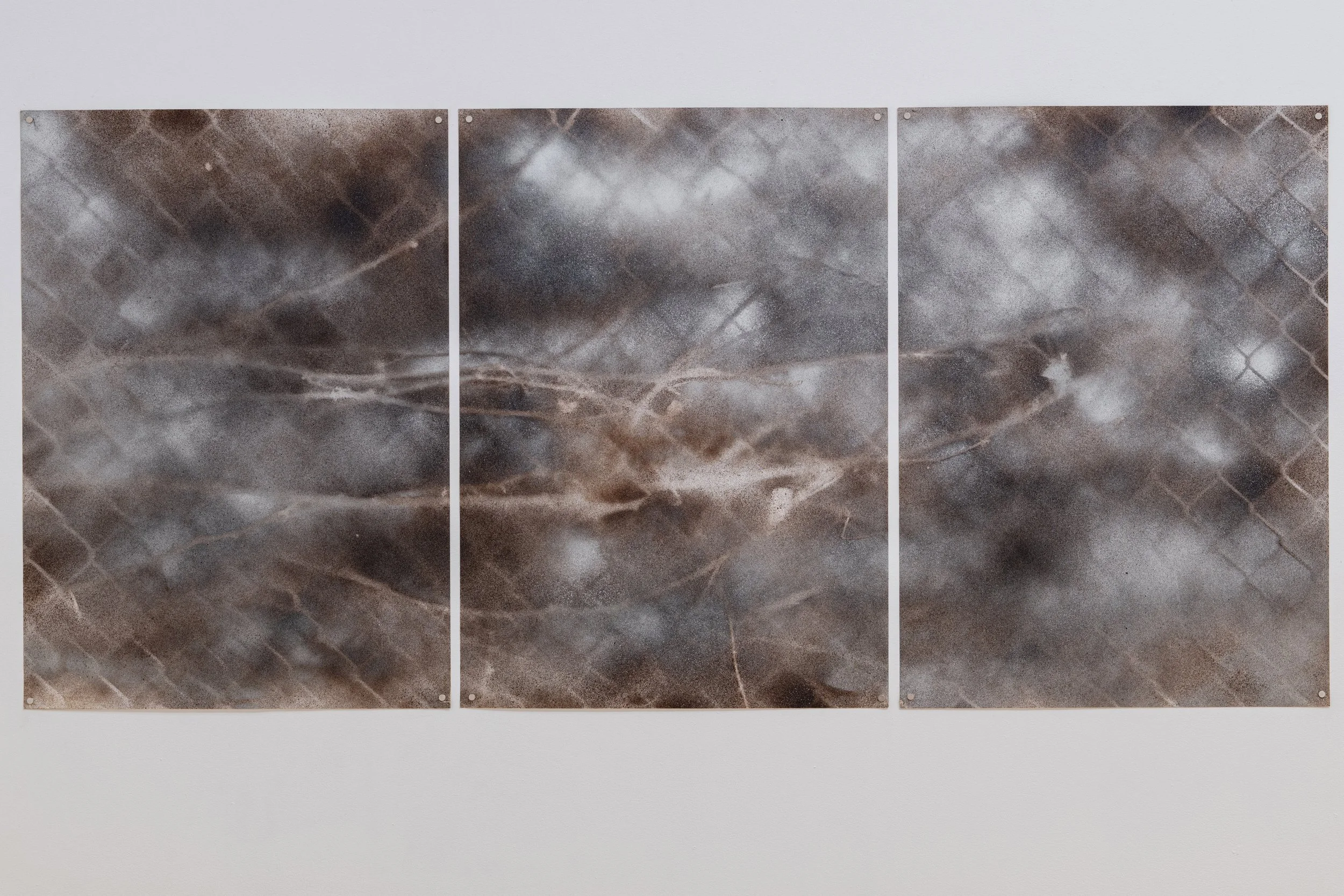
Cylena Simonds works across sculpture, installation, film, and works on paper. She draws on folktales, fairytales and urban Black experiences. She accesses these narratives through the prism of growing up in the urban landscape of Detroit – experiencing similar dilemmas of in/exclusion, tightly guarded territories, and violent predicaments.
Materials such as sprayed layers of bitumen and chrome car paint, and forms such as briars and chain-link fencing are chosen for their sensory qualities as well as for their social value - offering a dreamlike glimpse of safe passage through precarious terrain.
Briars - being both dangerous and protective - indicate the same trickster qualities that, in the traditional folk tale, allow Br’er Rabbit to hide and escape - being born and bred in the briar patch. In the same way, the chain-link fence operates as barrier, border, and record of territory – it references ongoing urban negotiations of who belongs where and on what terms, while also being permeable for those like Br’er Rabbit who’ve had to learn how!